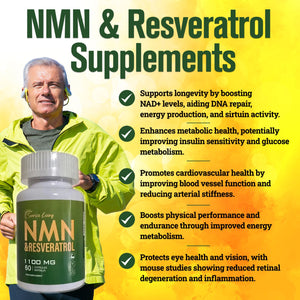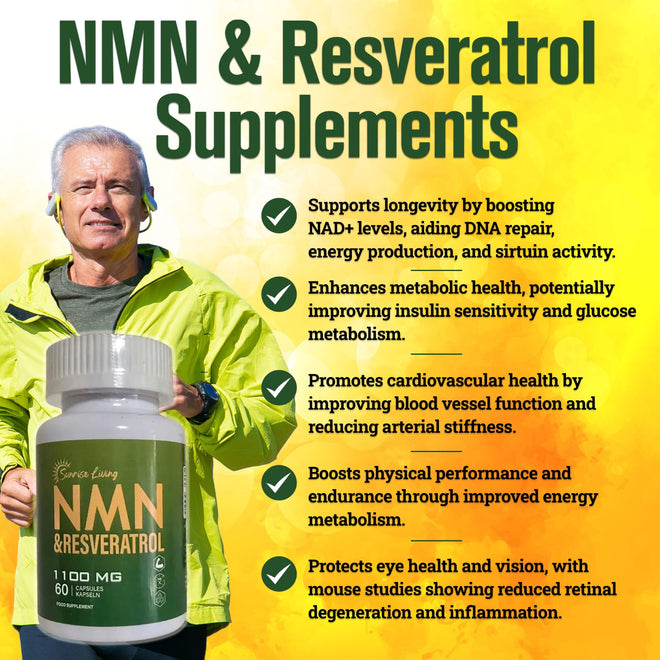
NMN & Resveratrol Supplements Australia
NMN (Nicotinamide Mononucleotide) and resveratrol are dietary supplements studied for their role in cellular energy metabolism and age-related biological processes. Interest in this combination has increased due to research on NAD⁺ decline with age and the role of cellular stress-response pathways in metabolic health.
What Are NMN and Resveratrol?
What Is NMN (Nicotinamide Mononucleotide)?
NMN is a naturally occurring compound found in small amounts in foods such as broccoli, cabbage, edamame, and avocado. In the body, NMN is a direct precursor to NAD⁺ (nicotinamide adenine dinucleotide), a coenzyme required for cellular energy production, DNA repair, and mitochondrial function.
NAD⁺ levels decline with age. Human studies show that NMN supplementation can increase NAD⁺ levels, which is why NMN is researched in the context of metabolic and age-related cellular changes.
What Is Resveratrol?
Resveratrol is a polyphenol present in grapes, berries, peanuts, and red wine. It is studied for its antioxidant properties and its interaction with proteins involved in cellular stress response, particularly sirtuins.
Resveratrol does not increase NAD⁺ levels directly but may influence pathways that rely on NAD⁺ for activity.
How NMN and Resveratrol Work Together
NMN and resveratrol are often discussed together because they affect related cellular pathways.
-
NMN increases the availability of NAD⁺
-
NAD⁺ is required for the activity of sirtuins
-
Resveratrol is studied for its role in influencing sirtuin activity
This complementary mechanism explains why the combination appears frequently in longevity and metabolic research. However, clinical evidence on combined supplementation in humans is still limited, and ongoing studies continue to evaluate outcomes.
The following effects are based on early human trials, animal studies, and mechanistic research. They should not be interpreted as medical claims.
Cellular Energy and Metabolism
NAD⁺ plays a central role in ATP production. By increasing NAD⁺ availability, NMN may support normal cellular energy metabolism.
Healthy Ageing Research
Research on NMN and resveratrol focuses on biological processes associated with ageing, such as mitochondrial efficiency, DNA repair, and cellular maintenance.
Metabolic Health
Some human studies suggest NMN supplementation may support insulin sensitivity and glucose metabolism. Resveratrol has also been studied for its effects on metabolic markers, though results vary.
Cardiovascular and Vascular Function
Resveratrol is widely studied for its antioxidant properties and potential role in supporting normal endothelial function.
Cognitive and Neurological Function (Emerging Research)
NAD⁺ is involved in neuronal energy metabolism. Research is ongoing to understand how NMN may relate to brain health during ageing.
Dosage recommendations are based on ranges commonly used in published research. Individual needs vary.
NMN Dosage
- Typical studied range: 250–500 mg per day
- Often taken earlier in the day due to its role in energy metabolism
Resveratrol Dosage
- Common range: 100–300 mg per day
- Often taken with food to support absorption
General Safety Profile
Short-term human studies indicate NMN is generally well tolerated in healthy adults. Resveratrol is also widely studied and commonly used in dietary supplements.
Reported Side Effects
Reported effects are typically mild and may include digestive discomfort, headache, or nausea.
Who Should Avoid or Seek Medical Advice
Pregnant or breastfeeding individuals
People undergoing cancer treatment
Individuals with chronic medical conditions
Those taking prescription medications
Key factors to consider:
- Independent third-party testing
- Clear ingredient labelling
- Identified NMN form (commonly β-NMN)
- Resveratrol source and stability
- Appropriate storage conditions
Does NMN increase NAD⁺ levels?
Yes. Human studies show NMN supplementation increases NAD⁺ levels in blood, though long-term outcomes are still being studied.
How long does NMN take to work?
Timeframes vary. Some metabolic changes are observed within weeks in studies, but individual responses differ.
Can NMN reverse ageing?
No. NMN does not reverse ageing. Research focuses on supporting normal cellular processes associated with ageing.
Is NMN safe for daily use?
Daily use is common in studies, but long-term safety data is still limited.